
Contribute
OceanSITES is a global community of ocean observers dedicated to open science and data sharing. By contributing their expertise, technology, and long-term time series data, members help advance our collective understanding of the ocean for the benefit of science and society. The network welcomes new site operators who wish to join this collaborative effort, share their observations, and help make ocean data globally accessible and reusable.
Benefits of joining
CONNECT AND BE PART
A GLOBAL PARTNERSHIP
OF SCIENTISTS AND
ENGINEERS.
GLOBAL VISIBILITY OF YOUR
LONG TERM OBSERVATIONS
VIA THE OCEANSITES
DISSEMINATION TOOL.
ACCESS GUIDELINES AND GET
ASSISTANCE TO MAKE YOUR
DATA FAIR FOLLOWING
INTERNATIONALLY RECOGNIZED
DATA FORMATS AND TOOLS.
EXPAND DATA USE AND
ACCESS SHARED
INFRASTRUCTURE.
RECEIVE SUPPORT TO
START NEW SUSTAINED
TIME SERIES PROGRAMS.
STRENGTHEN THE
SCIENTIFIC AND SOCIETAL
IMPACT OF YOUR WORK.
CONTRIBUTE TO MAJOR
PROGRAMS LIKE CLIVAR
AND GOOS
ACCESS TRAINING,
STUDENT OPPORTUNITIES,
AND LEADERSHIP ROLES
WITHIN OCEANSITES
The OceanSITES
Community
Each OceanSITES member is responsible for funding their own site(s) and covering travel costs, and participates in the OceanSITES Scientific Steering Committee. OceanSITES has an effective Data Management Team (DMT) that works with two Global Data Assembly Centers (GDACs)—one at the NOAA National Data Buoy Center and one at Coriolis (IFREMER)— and OceanOPS to ensure that data are delivered in a common format and made publicly available.
Members are expected to designate a point of contact for the DMT, which meets monthly by teleconference. The Scientific Steering Committee meets in person every one to two years, alongside the DMT. OceanSITES members and partners, all volunteers, support an Executive Committee in raising funds for project office operations hosted at OceanOPS in Brest, France.
How to Join
OceanSITES welcomes participation from new site operators who are not yet part of the network but wish to contribute to its global mission.
Operators interested in joining are encouraged to contact OceanSITES if their site meets the established observatory requirements:
OBSERVATORY REQUEREMENTS
MANDATORY
DESIRABLE
location, designed
for long-term
monitoring (typically
more than 5 years).
Operation at a fixed
location, designed
for long-term
monitoring (typically
more than 5 years).
Operation at a fixed
location, designed
for long-term
monitoring (typically
more than 5 years).
Operation at a fixed
location, designed
for long-term
monitoring (typically
more than 5 years).
The Executive Committee will review all submitted materials and make a recommendation to the Scientific Steering Team, which will then decide on the site’s inclusion in the OceanSITES network. Applicants are expected to include a clear statement of commitment to fulfilling the OceanSITES requirements.
SITES
Some requirements need to be fulfilled by the operators to build a coordinated observing system network and to be able to bring about the benefits of otherwise separate operators and research efforts. To become a participating SITE member of OceanSITES and share data from your platform(s), please follow these guidelines:
All OceanSITES are described in short 1-2 page site descriptions and metadata provided following templates (site_description_templat, csv_metadata_oceanOPS_template). From these, the site catalogue is constructed, maps are generated, information presented in interactive tools, and the descriptions are made available on the OceanSITES web page and OceanOPS. OceanSITES participants are required to provide the content for these documents and to provide updates.
OceanSITES supports diverse scientific interests but each site is operated under agreed upon procedures. Central to being an OceanSITE is the commitment to sustained observing, done following methodology that delivers documented, high quality data. The instrumentation must be calibrated, metadata submitted, the accuracy of instrument clocks and time bases verified, and whenever possible pre-deployment, in-situ, and post-deployment calibration procedures should be employed to document any drift or other changes in sensor performance. In short, the observations should be done to the present standards of the ocean sciences. Members of the Science Team must recognize and accept the responsibility to document ‘best practices’, to document the data qualities and uncertainties, and to work together to build capacity across the members. Thus, one requirement for being part of OceanSITES is that of active engagement in the group and commitment to supporting open access to quality data where that quality is well documented.
If possible, data should be in the form of an OceanSITES NetCDF, and members should follow these guidelines for submitting data.
In order to properly manage and share data successfully via the Global Data Assembly Centres (GDACs) (one in USA and one in France) or its national mandatory repository, each site needs to have its metadata form filled by the operator or data manager. This form is utilized by the GDACs and OceanOPS to make datasets available (on the web and in real-time for the meteorological and oceanographic communities) and is vital for users of OceanSITES data.
Opportunity
OPPORTUNITIES EXIST FOR
INVESTIGATORS TO USE BOTH
OCEANSITES DATA AND OBSERVING
PLATFORMS.
OceanSITES data are made openly available through the Global Data Assembly Centers (GDACs) at the NOAA National Data Buoy Center (NDBC) and Ifremer. Users are kindly requested to acknowledge the OceanSITES program when using these data.
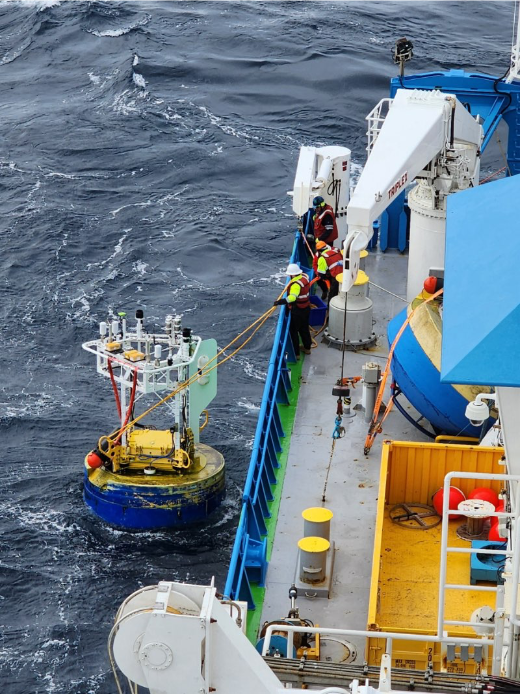
OceanSITES platforms also offer valuable opportunities for collaboration. Most OceanSITES sites consist of moorings that are regularly recovered and redeployed by the lead investigator to maintain long-term time series. While logistics and deployment costs are the responsibility of the lead investigator, the existing infrastructure may allow additional instrumentation to be integrated at moderate cost.
Investigators interested in adding instruments should contact the site’s lead investigator to explore feasibility. Any proposed instrumentation must meet strict requirements related to size, mass, mechanical specifications, corrosion resistance, and battery life, ensuring no negative impact on platform performance, durability, or deployment operations. Responsibility for instrument shipment, customs fees or taxes, and the provision of technical documentation and support rests with the investigator proposing the addition.
Meetings
UPCOMING MEETINGS
There are not upcoming meetings at the moment.